You sit down at a poker table for the first time. Someone flips over their cards, the dealer pushes a mountain of chips their way, and you're sitting there thinking: wait, does a flush beat a straight?
Every poker player has been there. The hand rankings are the foundation of the game, and if you don't know them cold, you're playing blindfolded. Doesn't matter how good your bluffing face is or how well you read people. If you can't instantly tell whether your hand wins or loses, you're going to bleed money.
This guide covers every hand from high card (the "I've got nothing" hand) up to the royal flush. What each one is, how often you'll actually see it, and where new players get tripped up. Bookmark this page. You'll come back to it.
The 10 poker hand rankings, worst to best
Here's the full list. When two players show down, the higher-ranked hand wins. No exceptions.
- High Card — Nothing. Your best single card.
- One Pair — Two cards of the same rank.
- Two Pair — Two different pairs.
- Three of a Kind — Three cards of the same rank.
- Straight — Five consecutive cards, any suits.
- Flush — Five cards of the same suit, any order.
- Full House — Three of a kind plus a pair.
- Four of a Kind — Four cards of the same rank.
- Straight Flush — Five consecutive cards, same suit.
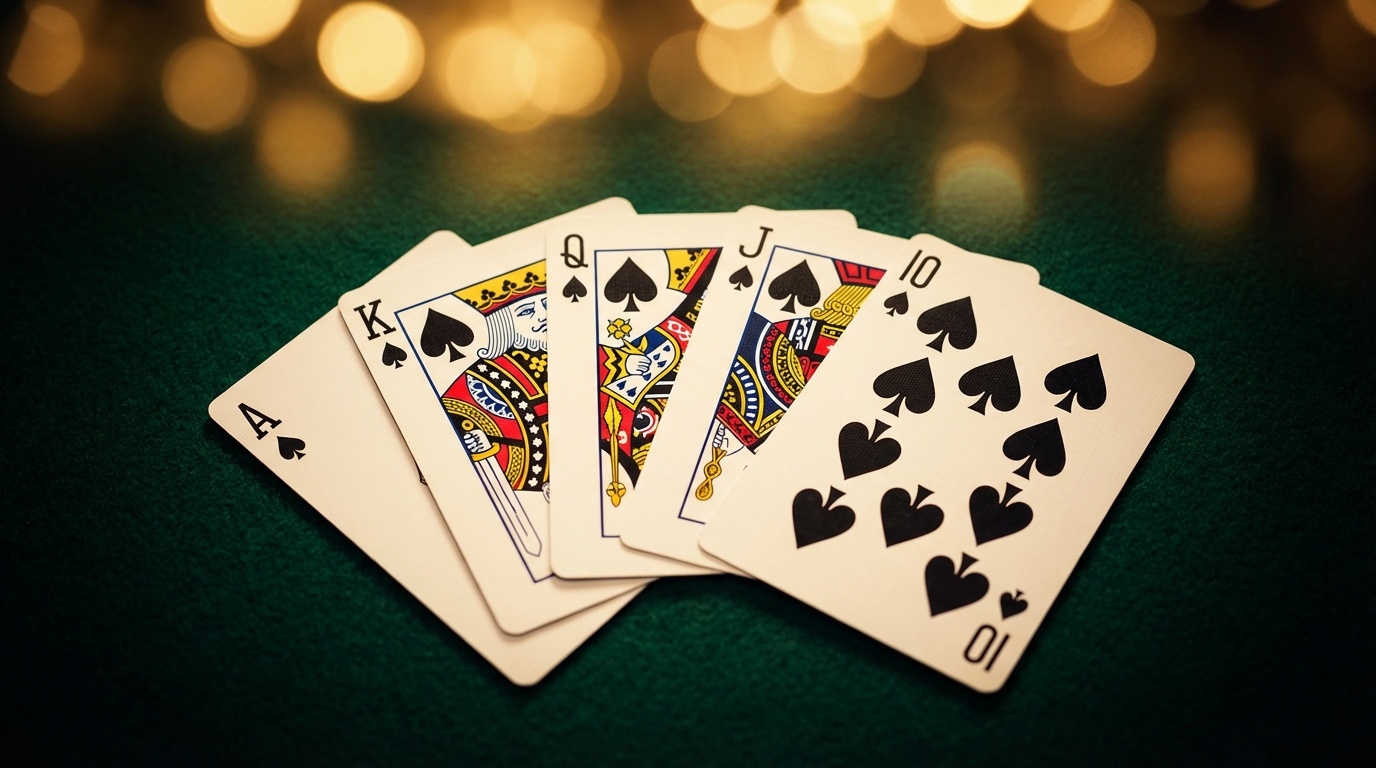
- Royal Flush — A-K-Q-J-10, all one suit.
Memorize that order. Now let's go through each one so there's zero confusion.
High card
When your hand doesn't match any of the categories below, it's scored by its highest card. Holding a King and a 7 with no pairs, no draws, nothing? You have "King high."
This is the weakest hand, and you'll have it more often than you'd like. About half the time you're dealt cards in Hold'em, you'll end up with nothing better than high card by the river.
Ties are broken by the highest card. Same high card? Compare the second, then third, and so on.
If you're reaching showdown with high card, something went wrong. You were either bluffing and got called, or you should've folded a lot earlier. High card winners happen, but they're not a plan.
One pair
Two cards of the same rank. That's it. Pair of Kings, pair of 5s, pair of anything. It's the most common made hand in poker, and it wins more pots than people think.
Higher pair wins. Queens over Tens, always. Same pair? The three remaining cards (kickers) break the tie, compared from highest to lowest.
Here's where beginners get burned: they pick up a small pair like pocket 4s and fall in love. A pair is a pair, sure. But 4s is barely better than high card. A pair of Aces and a pair of 3s are completely different hands in terms of what they can win.
Two pair
Two separate pairs in one hand. Pair of Kings and a pair of 7s? Two pair, Kings and Sevens.
The highest pair decides it first. Same top pair? Compare the second pair. Both match? The fifth card breaks it.
Two pair feels strong, and it often is. It's also the hand that costs intermediate players the most money. You flop two pair, think you're golden, then somebody turns over a set and you're broke. Two pair is good. It is not invincible.
Three of a kind
Three cards of the same rank. In Hold'em, it shows up two ways:
- A "set" is when you have a pocket pair and the board matches one. This version is hidden and profitable because nobody sees it coming.
- "Trips" is when the board pairs and you hold the third card. More obvious, since anyone with that card also has trips. The kicker decides.
Higher trips always wins. If both players have the same trips (possible when the board has a pair), kickers break it.
Sets print money. They're concealed, they're strong, and people pay them off all the time. Think about why position matters here: you flop a set in late position, someone bets into you, and you get to just flat-call while they keep building the pot for you.
Straight
Five cards in sequential rank. Suit is irrelevant.
Rules that trip up beginners:
- The Ace can be high (A-K-Q-J-10) or low (A-2-3-4-5), but it doesn't wrap around. K-A-2-3-4 is not a straight.
- A-2-3-4-5 is called the "wheel" (lowest straight). A-K-Q-J-10 is "Broadway" (highest).
The straight with the higher top card wins. 9-high beats 7-high.
New players often miss that they've made a straight because the five cards are split between their hole cards and the board. This is why learning to read the board quickly matters so much. Get in the habit of counting sequences every time the flop comes down.
Flush
Five cards of the same suit, any ranks. Five hearts, five spades, whatever the numbers happen to be.
Highest card in the flush wins. If those tie, compare the second-highest, and so on. An Ace-high flush (the "nut flush") always beats a King-high flush.
Here's the thing about flushes, though. When three or four cards of the same suit show up on the board, every player at the table can see that a flush is possible. If your highest suited card is a 7, you need to be careful. Anyone with a higher card of that suit has you dead. Having a flush doesn't automatically mean you can shove. Which flush you have matters.
Full house
Three of a kind plus a pair. Also called a "boat." Hands start getting seriously strong here.
The three-of-a-kind part decides it. Queens full always beats Jacks full no matter what the pair is. If both players have the same trips (rare in Hold'em), the pair breaks the tie.
One thing to burn into your memory: a full house beats a flush. This is probably the most commonly forgotten ranking among new players. A flush looks impressive with five matching suits, but a full house wins that fight every time.
Four of a kind
Four cards of the same rank, also called "quads." A monster you'll rarely see. The odds of making quads by the river in Hold'em are about 1 in 595.
Higher quads win. If two players somehow both have four of a kind (almost never happens), the higher set takes it. Board quads? The kicker decides.
When you flop quads, try not to grin. The hard part isn't winning; it's getting paid. Bet too hard and everyone folds. You want to let the other players build the pot, which comes back to understanding how to bet.
Straight flush
Five consecutive cards, all the same suit. A straight and a flush combined. This is the second-best hand in poker, and it's extraordinarily rare. The odds in a five-card hand are about 1 in 72,000.
Higher top card wins between two straight flushes.
Will you ever actually see one? Probably not soon. Most regular players go hundreds of sessions between straight flushes. And when you do make one, the real challenge is getting paid. Your opponents usually won't have anything worth calling a big bet with, so you might win a depressingly small pot with one of the best hands you'll ever hold.
Royal flush
A-K-Q-J-10, all one suit. The best hand in poker. It's technically just a specific straight flush, but it gets its own category because nothing beats it and nothing ties with it.
In a five-card hand, the probability is about 1 in 650,000. In Hold'em, with seven cards available, it's closer to 1 in 30,940. Most recreational players will never make one.
If you do hit a royal, congratulations. Now figure out how to get somebody to call your bet. That's the actual hard part.
Quick reference: what beats what
Cheat sheet. Screenshot this. Higher on the list beats everything below it.
| Rank | Hand | Example | Odds (Hold'em) |
|---|---|---|---|
| 10 | Royal Flush | A-K-Q-J-10 (suited) | 1 in 30,940 |
| 9 | Straight Flush | 5-6-7-8-9 (suited) | 1 in 3,590 |
| 8 | Four of a Kind | 9-9-9-9-K | 1 in 595 |
| 7 | Full House | Q-Q-Q-5-5 | 1 in 38 |
| 6 | Flush | A-J-8-5-2 (suited) | 1 in 33 |
| 5 | Straight | 5-6-7-8-9 | 1 in 21 |
| 4 | Three of a Kind | 8-8-8-K-4 | 1 in 47 |
| 3 | Two Pair | K-K-7-7-3 | 1 in 21 |
| 2 | One Pair | J-J-9-5-3 | 1 in 2.4 |
| 1 | High Card | K-9-7-4-2 | 1 in 2 |
Common mistakes and confusing spots
These are the ranking errors that burn new players the hardest:
"Does a flush beat a straight?"
Yes. Always. Flush (same suit) beats straight (consecutive cards). Just memorize it.
"Does three of a kind beat two pair?"
Yes. People get confused because two pair involves four matching cards while three of a kind only has three. Doesn't matter. Three of a kind is higher.
"Do suits have a ranking?"
In almost all poker games, no. Hearts don't outrank spades. When comparing two flushes, the card ranks within each flush decide the winner. Some cardrooms use suit order for edge-case tiebreakers like who gets the button, but that varies by house.
"But my two pair uses all five cards and their trips only uses three."
The hand rankings are the hand rankings. Three of a kind beats two pair regardless of how many cards are "involved" in each.
"What's a kicker?"
The highest card in your hand that isn't part of your main combination. If you and another player both have a pair of Kings, whoever has the higher remaining card wins. Kickers matter a lot. They decide more pots than you'd expect and are behind a huge number of bad beats.
What to remember
- 10 hand rankings. Learn them in order.
- The one most people forget: flush beats straight, full house beats flush.
- Kickers break ties. Pay attention to them.
- Suits don't decide winners between two hands of the same rank.
- Two pair and flushes look good but still lose to plenty of hands. Don't fall in love.
- The Ace works as both high (Broadway: A-K-Q-J-10) and low (wheel: A-2-3-4-5) but doesn't wrap around.
If you're new, this plus a solid grasp of the basic rules will put you ahead of most first-timers. Learn these rankings until they're reflexive, and you'll never have that "wait, who won?" moment at the table.