
Poker has rules. Not a ton of them, honestly, but the ones that exist matter. Get one wrong and you'll either lose money you shouldn't have or annoy everyone at the table. Possibly both.
We're going through every rule you need before sitting down at a Texas Hold'em table, which is what 90% of people mean when they say "poker." Setup, dealing, betting, showdown, and the weird edge cases that trip people up. If you've never played a hand or you've played a few and still feel lost, start here.
The deck and the table
Poker uses a standard 52-card deck. No jokers, no wild cards (in standard games). Four suits: hearts, diamonds, clubs, spades. Each suit has 13 cards from 2 (lowest) through Ace (highest).
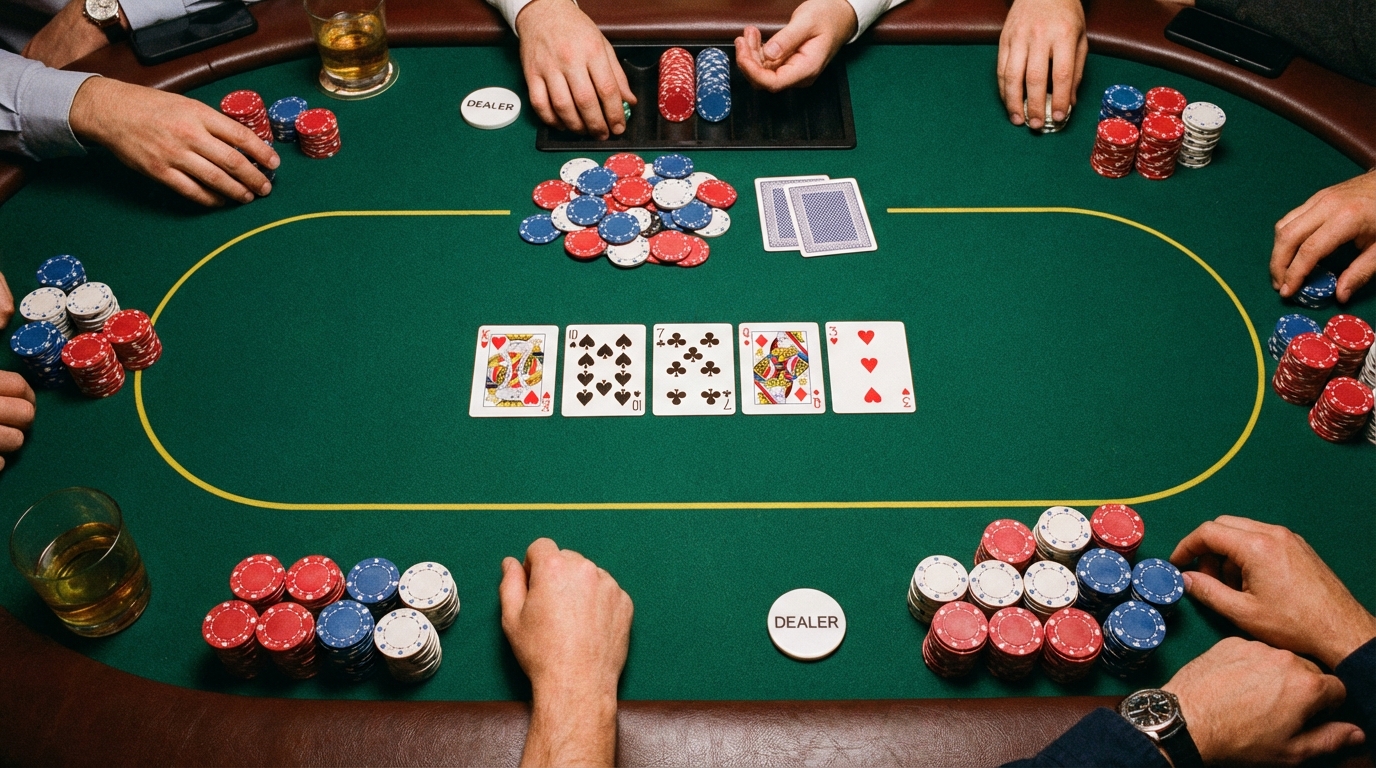
A Hold'em table seats anywhere from 2 to 10 players. Most games run with 6 or 9. One spot at the table has a round disc called the dealer button sitting in front of it, and it moves clockwise after every hand. The button is a bigger deal than it looks. It decides who pays the forced bets and who acts in what order.
Forced bets: blinds and antes
Before anyone looks at their cards, two players have to put money in. The player directly left of the button posts the small blind (usually half the minimum bet). The player two seats left posts the big blind (the full minimum bet).
These forced bets exist for one reason: so there's money to fight over. Without them, the optimal strategy would be to fold every hand until you get Aces, and nobody would ever play.
Some games also use antes, which are small forced bets from every player at the table. Antes are more common in tournaments than cash games. They make pots bigger from the start, which speeds up the action.
How cards are dealt
Each player gets exactly two cards face down. These are your hole cards. Only you can see them. The dealer starts with the player to the left of the button and goes clockwise, one card at a time, two passes around the table.
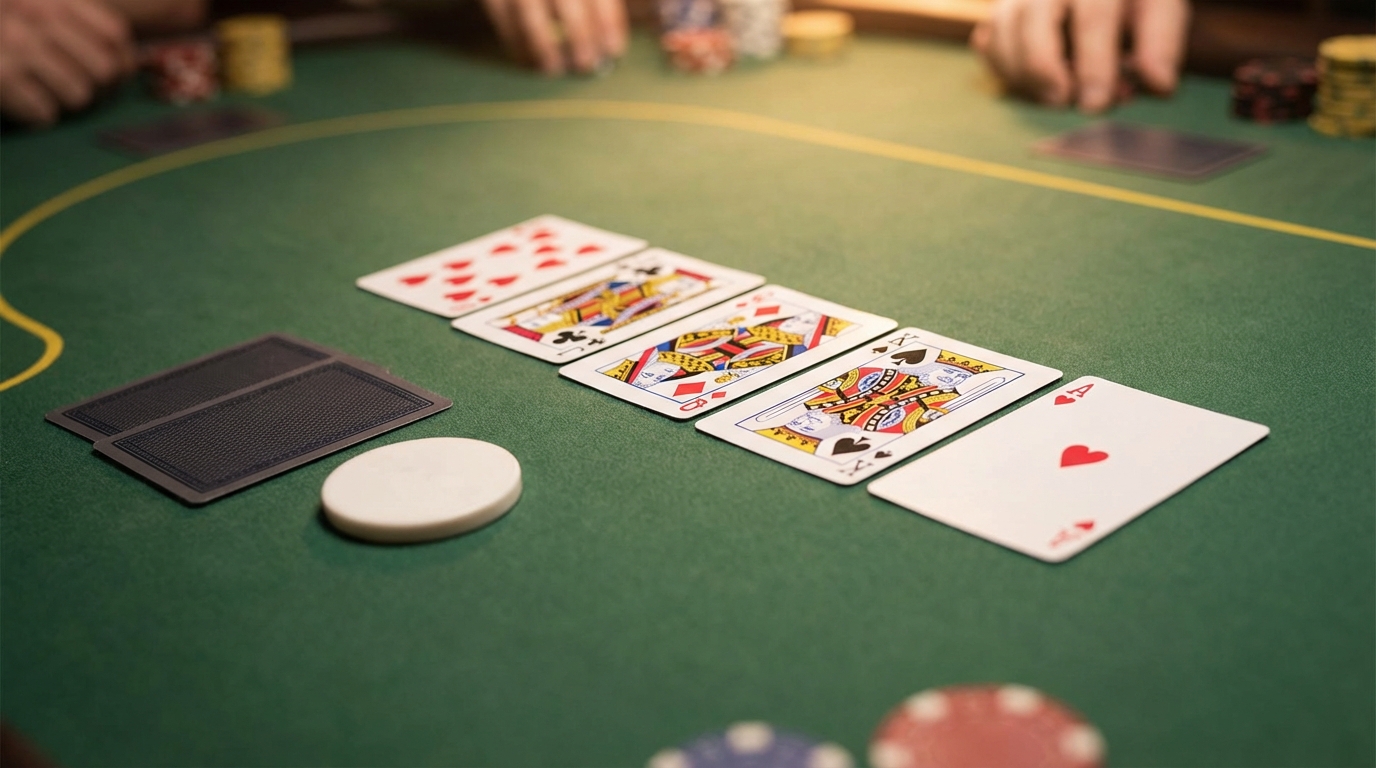
After everyone has their hole cards, five community cards are dealt face up in the center of the table across three stages:
- The flop -- three cards at once, after the first betting round.
- The turn -- one card, after the second betting round.
- The river -- one final card, after the third betting round.
Before each community card stage, the dealer "burns" (discards face down) one card from the top of the deck. This is a holdover from the old days when it helped prevent cheating. Nobody looks at burn cards.
Your final hand is the best five-card combination you can make from your two hole cards plus the five community cards. You can use both hole cards, one, or neither. Whatever makes the strongest hand.
What you can do when it's your turn
When it's your turn, what you can do depends on what's happened before you in that round.
Fold
Throw your cards away. You're done with this hand. Any money you've already put in stays in the pot.
Check
Pass the action to the next player without betting. You can only check if nobody before you has bet in the current round. Think of it as saying "I'm still in, but I'm not putting anything in right now."
Bet
Put chips into the pot when nobody else has bet yet this round. In No-Limit Hold'em, the minimum bet is the size of the big blind. You can bet up to your entire stack.
Call
Match the current bet to stay in the hand. Someone bet $10? You put in $10.
Raise
Increase the current bet. In No-Limit, the minimum raise is at least the size of the previous bet or raise. So if someone bets $10, you must raise to at least $20. You can also just shove your entire stack in.
The four betting rounds
There are four betting rounds in a hand of Hold'em, each one separated by new community cards hitting the board. Every round works the same way: action starts left of the button (left of the big blind pre-flop), goes clockwise, and ends when everyone left has put in the same amount.
| Round | When | Cards on board |
|---|---|---|
| Pre-flop | After hole cards are dealt | None (just your two cards) |
| Flop | After three community cards | 3 cards |
| Turn | After fourth community card | 4 cards |
| River | After fifth community card | 5 cards (all dealt) |
If at any point during a betting round everyone folds except one player, that player wins the pot immediately. No more cards are dealt. No showdown. This is how a lot of poker hands end, actually. Most pots are won by the last person standing, not by whoever has the best cards.
Hand rankings: what beats what
You need to know these. There's no getting around it. From weakest to strongest:
- High card -- nothing connects, your best card plays.
- One pair -- two cards of the same rank.
- Two pair -- two separate pairs.
- Three of a kind -- three cards of the same rank.
- Straight -- five consecutive cards, any suits.
- Flush -- five cards of the same suit, any order.
- Full house -- three of a kind plus a pair.
- Four of a kind -- four cards of the same rank.
- Straight flush -- five consecutive cards, same suit.
- Royal flush -- A-K-Q-J-10, all one suit. The best hand in poker.
The one that gets people: flush beats straight. Full house beats flush. Commit that to memory. For the deep dive with examples and odds, read the full hand rankings guide.
The showdown
If two or more players are still in after the final betting round (the river), they reveal their cards. Best five-card hand wins. Ties split the pot evenly.
Who shows first? Technically, the last person who bet or raised on the river shows first. If everyone checked, the player closest to the left of the button shows first. In practice, especially in casual games, people just flip their cards over and the dealer sorts it out.
You can also "muck" your hand at showdown, which means you fold without showing. You forfeit the pot, but your opponents don't get to see what you had. Some players do this to hide information about how they play. In online poker, you sometimes get to see mucked hands in the hand history anyway.
The pot (and side pots)
All the chips bet during a hand go into the pot. The winner takes the whole thing. Simple enough.
Where it gets weird is all-in situations. Say the pot is $50 and Player A shoves their last $20. Player B calls $20. Player C raises to $60. Player A can only win $20 from each person (their "main pot" of $60 plus what was already there). The extra money from B and C goes into a "side pot" that Player A has no claim to. They didn't put enough in to compete for it.
Side pots sound confusing, and they are at first. But the rule is straightforward: you can only win from each opponent up to the amount you put in. The dealer handles the math.
Rules people break without realizing
These aren't about cards or chips. They're the procedural stuff that new players get called out for at the table, sometimes not very nicely.
Act in turn
Wait until it's actually your turn before you do anything. Don't fold, check, or bet out of order. It gives information to other players and messes up the action. In a casino, the dealer will tell you if it's your turn.
Announce your action
Say "raise" or "call" clearly before moving chips. In many rooms, if you silently put out enough chips for a call but intended to raise, you're stuck with a call. Verbal declarations are binding.
Don't string bet
A "string bet" is putting out chips in multiple motions without announcing your total. If you put out $20, pause, then add $30 more without saying "raise" first, the extra $30 gets pulled back. Either announce "raise to $50" or push all the chips forward in one motion.
Protect your cards
Keep your hole cards on the table in front of you with something on top of them (a chip, a card protector). If your cards get accidentally scooped up by the dealer, your hand is dead. This happens more than you'd think.
Don't show your cards mid-hand
If you fold, don't flash your cards to the person next to you. Don't tell anyone what you folded while the hand is still going. Both give unfair information to players still in the hand.
Raise sizing rules
This trips up new players constantly. In No-Limit Hold'em:
- The minimum bet on any street is the big blind.
- The minimum raise must be at least the amount of the previous bet or raise. If someone bets $10, you have to raise to at least $20 (not $15).
- There is no maximum bet. You can push your entire stack in at any time. That's the "No-Limit" part.
- Once you say "raise" or push chips forward, you're committed to at least a minimum raise. You can't take it back.
In Limit Hold'em (less common now), bet sizes are fixed. You can only bet or raise in preset increments. In Pot-Limit, the maximum raise is the size of the current pot.
Going all in
If you don't have enough chips to call a bet, you can go "all in" for whatever you have left. You stay in the hand but can only win from each opponent the amount you put in.
Quick example: there are three players. You have $30. Someone bets $100. You call all in for $30. A third player also calls $100. You can win $30 from each of them (your $30 main pot = $90 total). The $70 extra from each of the other two players goes in a side pot that you're not eligible for.
All-in rules exist so you're never forced out of a hand just because someone has more chips than you. If your hand is best, you win what you put at risk.
Why position matters
Not technically a "rule," but you'll play worse without knowing it. The player on the button acts last on every post-flop betting round. They get to watch everyone else act before deciding what to do. That's a huge edge, and it's free.
Early position (first to act) means you need a stronger hand because you have no idea what anyone else is doing. Late position lets you play looser because you've already seen everyone else act. There's a full breakdown on table positions and why they matter.
Now go play
Those are the rules. All of them, for standard Texas Hold'em. Some poker variants have extra wrinkles (Omaha gives you four hole cards, Stud has no community cards), but if you know Hold'em rules, you're 80% of the way to understanding any poker game.
If you want to understand how a hand actually flows from start to finish, the step-by-step Hold'em guide walks through a complete hand with example betting. And if you keep mixing up which hand beats which, the hand rankings page has you covered.
The best way to learn rules is to play. Grab some friends, deal some cards, and mess up a few times. Everyone does. The rules lock in fast once you've got chips in front of you.