You already know poker exists. You probably know people bet and someone wins. But the actual turn-by-turn mechanics of a Hold'em hand? That's where most people get hazy. They sit down, cards come out, and they spend the next hour asking "wait, is it my turn?"
This is the stripped-down version of Texas Hold'em rules. No history lessons, no strategy advice, no "here's why poker is a beautiful game" filler. Just what happens, in what order, and what you're allowed to do at each step.
Players and setup
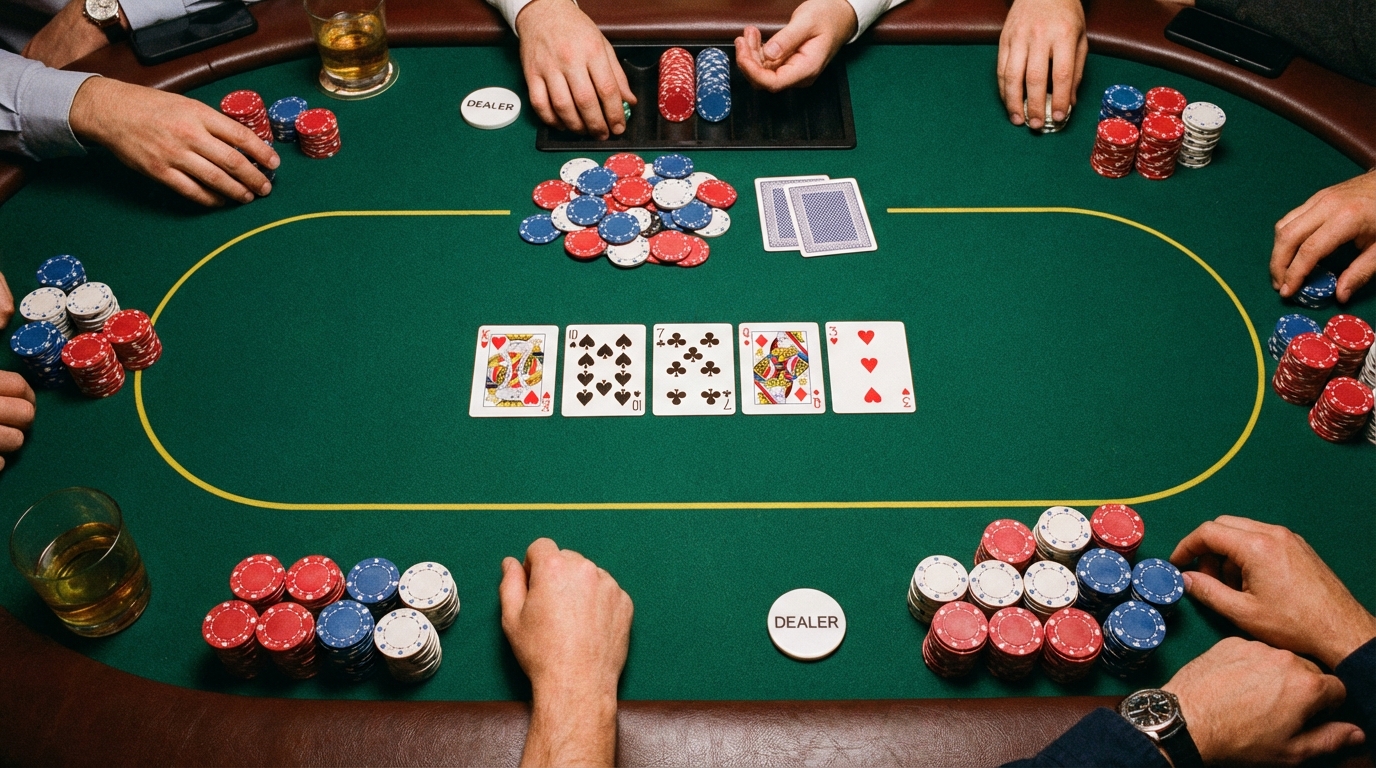
You need 2 to 10 people and a standard 52-card deck. No jokers. One player has a round plastic disc in front of them called the dealer button. It doesn't mean they actually deal the cards (a designated dealer or the app handles that). The button just marks a position, and it moves one seat clockwise after every hand.
Why does the button matter? Because it decides two things: who pays the forced bets, and who acts in what order. The entire flow of the game hangs on where that little disc is sitting.
The blinds
Two players pay forced bets before cards are dealt. The person directly left of the button puts in the small blind. The person two spots left puts in the big blind, which is double the small blind.
In a $1/$2 game, that's $1 and $2. In a $5/$10 game, $5 and $10. The big blind also sets the minimum bet size for the hand.
Blinds rotate with the button. You'll pay them every orbit around the table. Nobody gets to dodge them forever.
Hole cards: your two private cards
Everyone gets two cards face down. You look at yours. Nobody else sees them. These are your hole cards, and combined with the community cards that come later, they'll determine whether you have anything worth playing.
Two cards doesn't sound like much, and it isn't. That's the whole point. With so little private information, most of the game is about what you do with incomplete knowledge. A pair of Aces is the best starting hand. A 7-2 offsuit is the worst. Everything else falls somewhere in the middle, and knowing roughly where takes practice. The hand rankings guide covers how finished hands compare.
Pre-flop: the first betting round
Action starts with the player to the left of the big blind. They look at their two cards and decide:
- Fold and toss the cards. Done. No cost beyond any blind already posted.
- Call by matching the big blind amount.
- Raise to a higher amount. Everyone after them must match the new price, raise again, or fold.
This goes clockwise around the table. The big blind acts last. If nobody raised, the big blind can check (stay in for free, since they already posted) or raise.
Pre-flop is fast at most tables. A lot of hands get folded here because most two-card combinations aren't worth playing. If you're new and unsure, folding more is almost always the right instinct.
The flop: three community cards
The dealer burns one card (sets it aside, face down), then deals three cards face up in the middle of the table. These are community cards. Everyone uses them.
Now you've got five cards to think about: your two hole cards plus these three. You might have a pair, a draw to a straight or flush, or nothing at all.
Another betting round happens. This time action starts with the first active player left of the button (not the big blind). Same options: check, bet, call, raise, or fold. The round ends when everyone remaining has put in the same amount, or everyone checks.
The turn: fourth community card
Another burn card, then one more community card dealt face up. Four cards on the board now, six total when you count your two hole cards.
Another betting round, same structure as the flop. Bets usually get bigger here. The pot has grown, hands are more defined, and people with weak holdings start feeling the pressure to either commit or get out.
The river: fifth and final community card
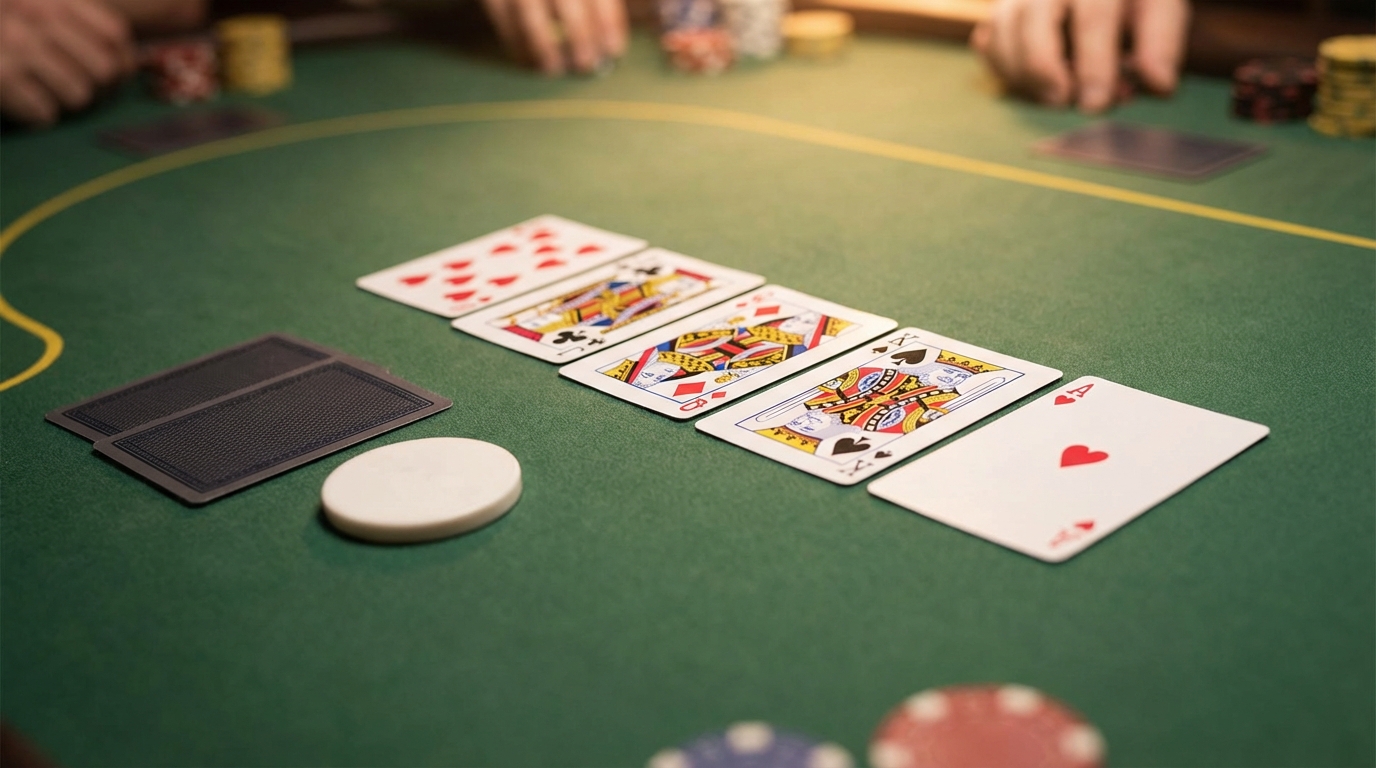
Last burn, last card. Five community cards on the board. Your final hand is the best five cards you can assemble from the seven available to you (two hole cards + five board cards).
One more betting round. After this, anyone still in the hand shows their cards.
Showdown
If multiple players are still in after the river betting round, cards get flipped over. Best five-card hand wins the pot. If two hands are identical, they split it.
You don't have to use both hole cards. You don't have to use either of them. If the five board cards make a straight and nobody can beat it with their hole cards, everyone still in chops the pot. That's called "playing the board," and it happens occasionally.
If you don't want to show your cards, you can muck them (fold face down). But you forfeit any claim to the pot. Players muck at showdown when they know they're beaten and don't want to give away information about what they were playing.
Winning without showing cards
Here's the thing most people don't realize right away: the majority of Hold'em hands never reach showdown. Somebody bets, everyone else folds, the bettor takes the pot. No cards revealed. No proof they had anything.
This is why poker is a betting game, not a card game. You can win with the worst hand at the table if everyone else folds. That's not cheating, it's the game working as designed.
Quick reference: rules people mess up
The minimum raise
Must be at least the size of the previous bet or raise. If someone bets $10, the minimum raise is to $20, not $15. In No-Limit, there's no maximum. You can always push all your chips in.
The Ace wraps low but not around
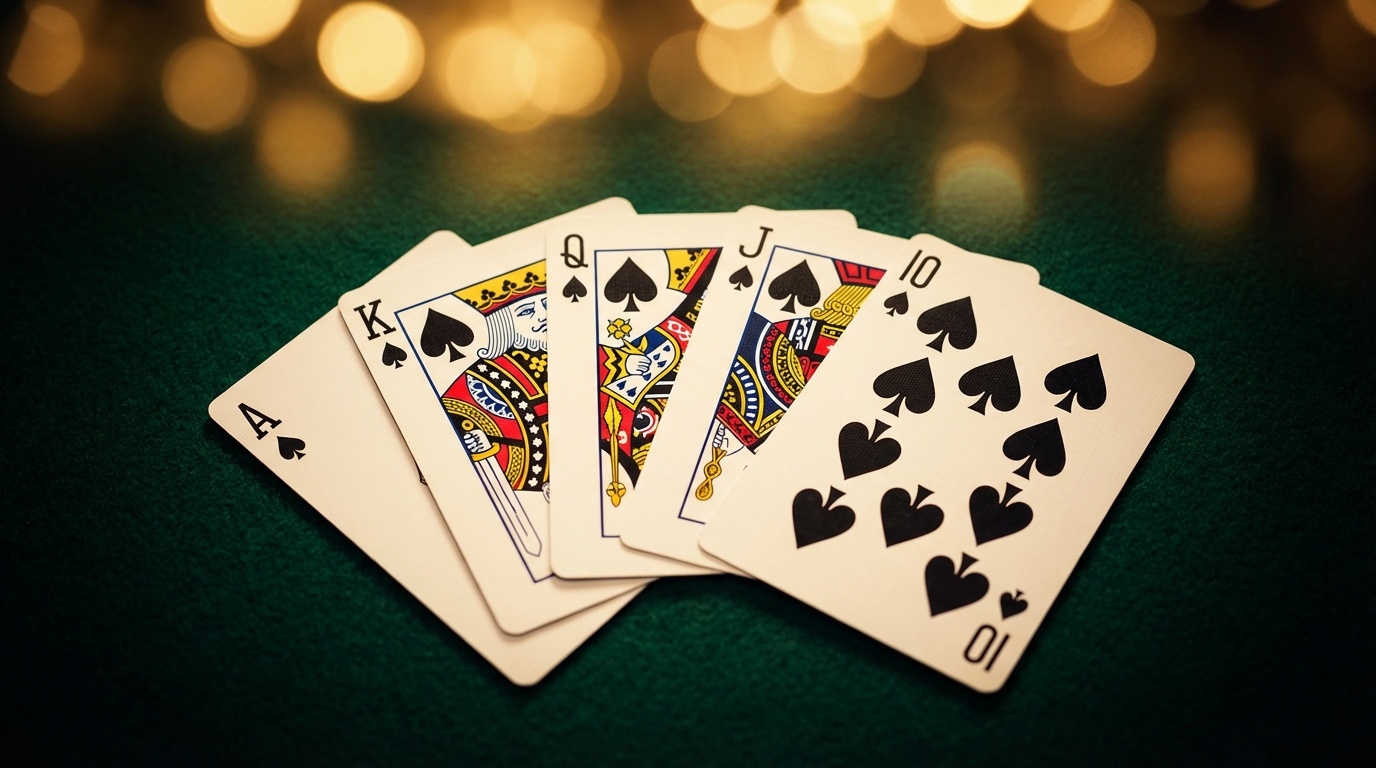
A-2-3-4-5 is a valid straight (the "wheel"). A-K-Q-J-10 is a valid straight ("Broadway"). But K-A-2-3-4 is not a straight. The Ace doesn't wrap around.
Suits don't rank
Hearts aren't better than spades. If two players have identical flushes in different suits, they split the pot. Suit rankings occasionally come up for who gets the button in specific tiebreakers, but during actual hand play, suits are equal.
All-in creates side pots
If you go all in for less than the current bet, you can only win the portion of the pot you were able to match. The rest goes into a side pot between the remaining players. The dealer sorts this out.
Verbal is binding
If you say "raise" out loud, you're raising. If you say "call," you're calling. Even if you then try to push more chips in, the verbal declaration stands. Say what you mean before you touch your chips.
One more thing: position
This isn't a rule exactly, but it'll change how you think about every hand. The player on the button (and the seats close to it) act last on every post-flop round. That means they see everyone else act before making a decision. That's a massive advantage.
Players in early position (first to act) are flying blind. They need stronger hands to compensate. If you want to understand why some seats are better than others, the table position guide breaks it down.
That's the whole game
Button moves. Blinds go in. Two cards each. Bet. Flop. Bet. Turn. Bet. River. Bet. Best hand wins, or last person standing takes it. That's Texas Hold'em.
If you want a more detailed walkthrough with a full example hand and betting math, the step-by-step beginner's guide goes deeper. And if you're foggy on which hands beat which, the hand rankings page has every hand from high card to royal flush with examples.
Best thing you can do now is play some hands. Doesn't matter if it's a free app, a home game with friends, or penny stakes online. The rules stick once you've been through a few orbits.